“Teaching and Informing Are Different”
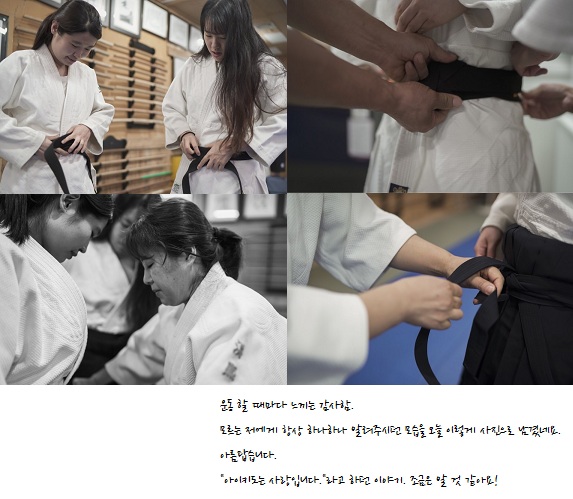
At the Aikido Jeju branch dojang, everyone wears the same white belt until they become a black belt. It’s common for it to take as little as 2 years or, in longer cases, more than 5 years to receive a black belt certification. So people who first walk through the dojang doors often get curious. All the belts look the same, so how is seniority distinguished here…? To answer this question, we first need to untangle the idea that seniority relationships in Aikido aren’t determined solely by dan (rank) or belt color. Today, even amid Aikido etiquette, I’d like to share my personal thoughts on how seniors should treat juniors, how juniors should treat seniors, and the misunderstandings that frequently arise in between.
Why Seniority Still Matters Even When Everyone Wears White Belts
Due to the nature of the dojang space, seniors and juniors are usually divided by belt color or dan rank. But the story is different in a dojang like the Aikido Jeju branch, where everyone is unified under a single white belt until they reach black belt. Just because they’re wearing the same white belt doesn’t mean all the members joined at the same time. There are white belts who have been training for three years, and white belts who just started their very first class. Since there’s no distinction by belt color, it doesn’t mean the concept of seniority disappears. If anything, because it doesn’t show on the outside, it becomes a structure where we need to pay closer attention to each other’s training history and attitude.
Aikido is a martial art with almost no concept of winning or losing through competition. That’s why some people call Aikido the weakest martial art, while others call it the most refined martial art. I fall into the latter camp. Because it doesn’t involve competing to win, Aikido practitioners tend to grow closer to one another, and the wall between seniors and juniors tends to be lower. But that’s exactly why courtesy can also easily crumble. In a martial art where Aikido imitates the master, and winning or losing has nothing to do with it, seniority naturally has to be divided somehow. And it’s precisely at this point that both big and small conflicts arise.
What’s the Difference Between Teaching and Informing?
Trainees’ skills are, for the most part, clumsy and lacking compared to what the instructor sees. So sometimes a senior tries to teach a junior, and conversely, sometimes a junior ignores the senior, saying “That’s different from what the instructor teaches.” Within this awkward tangle, both big and small problems within the dojang begin.
What “Teaching” Seniors Look Like
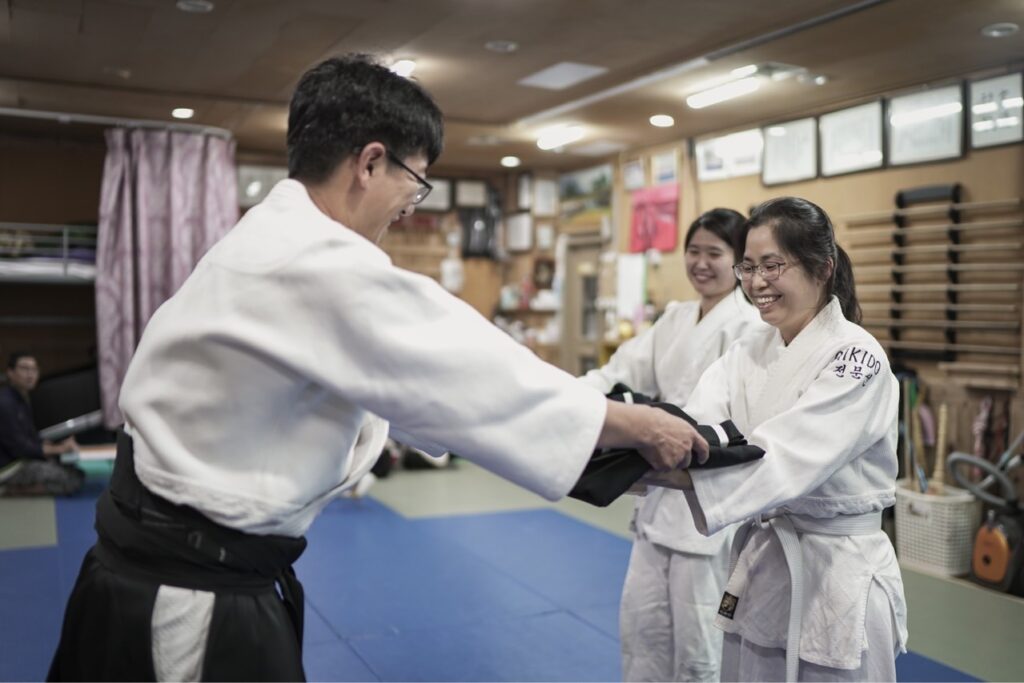
Teaching is, in essence, an act that only an instructor performs for someone they are training. Only someone who clearly knows what went wrong can really do it. But when a senior who is still clumsy in the instructor’s eyes tries to teach a junior, the attitude that comes across to the junior can feel condescending. A junior who’s not in a good mood, knowing the senior’s technique also differs from the instructor’s, doesn’t take the senior’s goodwill very well. And in doing so, they sometimes show a dismissive attitude, saying “Your technique is different from the instructor’s anyway.” Yet the head instructor repeatedly urges seniors to kindly inform their juniors. Many senior-junior pairs experience confusion here — because they don’t know the difference between teaching and informing.
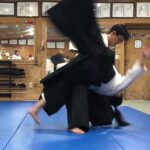
During training, you often see seniors receiving juniors’ techniques half-heartedly. They point out that the technique is wrong, and yet they take it carelessly until it’s properly executed, quietly dismissing the junior’s effort… This is exactly what “teaching” looks like.
What “Informing” Seniors Look Like
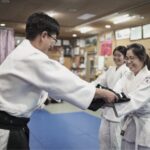
So what does it mean to inform? Even if the junior’s technique is clumsy, it means diligently receiving that technique all the way through so they can properly master it. The difference between an instructor and a senior lies right here. An instructor sees to it that training continues until the technique they’re teaching can be repeated correctly, even if it’s clumsy. But most seniors fail to show that kind of patience. I think the most necessary attitude between Aikido seniors and juniors is precisely this “informing” posture.
How Should Juniors Treat Seniors?
Juniors also cannot avoid situations where they have no choice but to train with seniors. Whether receiving or giving a throw, in that moment, giving your best effort comes first. In this process, making comparisons like “That senior’s like this, but why is that senior like that” isn’t right. That’s because it’s not courtesy toward the person who’s showing you goodwill. I believe the basics of martial arts etiquette ultimately start with respecting your partner’s effort exactly as it is.
When Does One Truly Become a Senior?
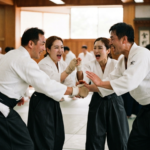
Becoming someone’s senior naturally happens as time passes. But becoming a true senior is different. It’s completed precisely when you act in a way that earns the junior’s respect, and the junior themselves acknowledges you as a senior. Joining earlier doesn’t unconditionally make you a senior. In the end, mutually acknowledging one another — I believe this is the lesson we need to learn in Aikido’s senior-junior relationships.
If you practice martial arts for a long time, you come to clearly realize that belt color or dan rank is, in the end, just a number. What truly matters is how that person behaves inside the dojang, and outside the dojang. This would hold true even outside of Aikido. Whether at work or among friends, it’s not that everyone who joined earlier is automatically a senior, and everyone who came later is automatically a junior. I too occasionally reflect on whether I’m properly fulfilling the role of a proper senior. Today too, at the Jeju Aikido dojang, sweating it out together with trainees wearing white belts, I once again resolve to become a senior who informs rather than teaches.
#Aikido #AikidoSeniorityJuniority #AikidoEtiquette #JejuAikido #MartialArtsEtiquette #AikidoTraining #WhiteBeltTraining #AikidoSpirit








“In the end, mutual recognition of one another—I think that’s the lesson we need to learn in the senior-junior relationships within Aikido.”
—> I 100% agree. I’m convinced that when we acknowledge each other’s differences while finding our own style, we avoid falling into dogmatism and can move forward into a deeper, wider world.