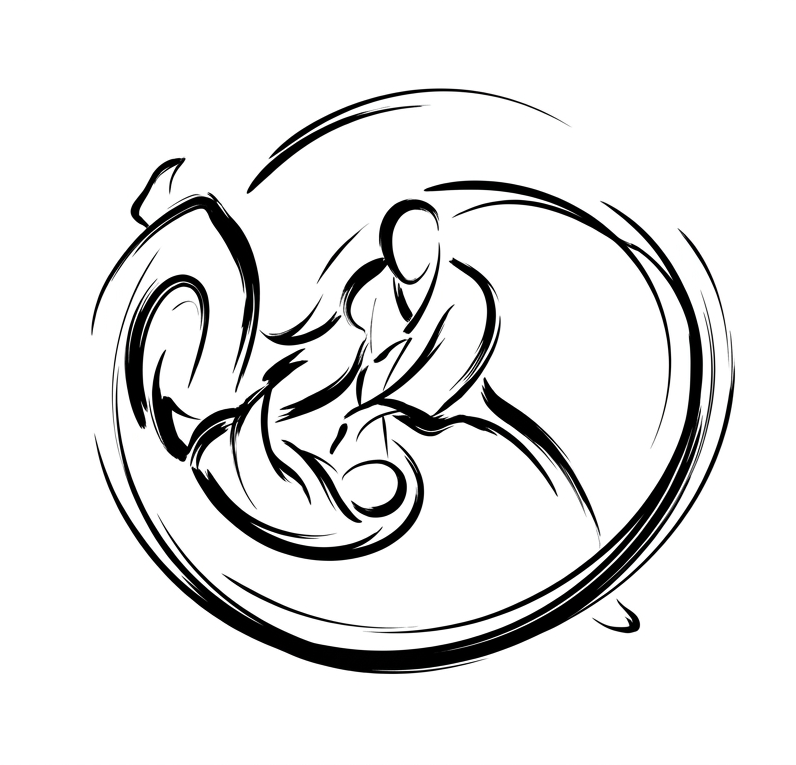
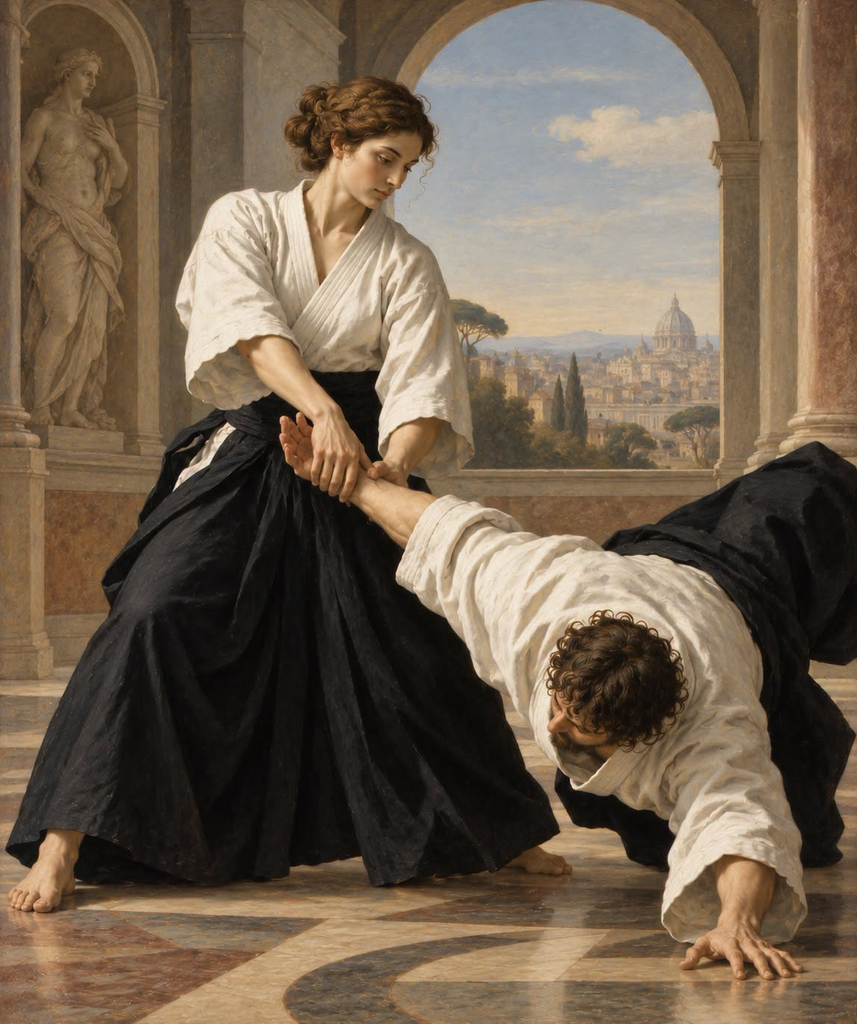
When someone encounters Aikido for the first time, what strikes them most is not any single thing but the movement of two people. One person attacks, and the other enters, redirects the force, and leads the attacker away. So it is only natural that Aikido is often classified as a type of physical discipline, a form of self-defense, or simply one martial art among many.
And yet, we often use the word “art” when talking about Aikido. Why is that?
Perhaps the most obvious answer lies in technique. Just as a musician must first learn notes, scales, harmony, and grammar before expressing themselves freely, a person training in Aikido spends a long time learning movement, distance, timing, and direction. At first, one observes, imitates, and repeats. One strives to reproduce a fixed form as precisely as possible. For a long time, that is what proper training looks like.
But that doesn’t mean nothing happens simply because the grammar isn’t yet perfect.
Countless repeated movements, as time flows by, quietly transform into a single language within the task one must simply perform. That is also why, even when practicing the same technique, entirely different results emerge from person to person. Bodies, ages, experiences, and sensibilities differ, and above all, the way each person receives their partner differs. It’s as if two pianists, playing the same score, never produce quite the same sound.
The technique still remains in its place, but at some moment it becomes almost imperceptible to the eye—because it has become fully absorbed into the body. And right at that moment, something residing deep within artistic experience begins to reveal itself.
Beauty.
Certain movements in Aikido are simply felt as beautiful. Sometimes it’s even hard to explain exactly why. It’s not necessarily because the movement is flashy or elegant. Rather, it’s often in a moment of stark contrast that we feel a deeper sense of admiration. A simple yet essential movement—one so precise in its timing and motion and intention that it seems to fall exactly into its rightful place.
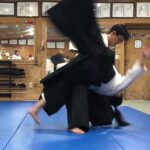
There are moments when two people, who were fighting until just an instant before, suddenly appear to form a single shape together. That is a particular kind of beauty—one that arises not from what belongs to one person alone, but from what emerges between two people.
In my view, this is precisely the point at which Aikido begins to take on the character of poetry.
A poem, as I see it, is not simply about stringing together beautiful words. It’s about moving something within someone through those words. If that is so, there’s no reason the movement of a body can’t become a poem as well. A body can convey simplicity and delicacy, strength and lightness, unease and calm. Even someone watching who doesn’t know the names of the techniques and can’t understand exactly what is happening can still be moved in their heart.
We are moved by music even without knowing the principles of harmony. In the same way, even without knowing Aikido, one can feel the beauty that emerges from the encounter between two people.
And for that encounter, there is one more condition I believe is essential to this art.
Namely, communication.
In Aikido, two people carry on a long conversation without exchanging a single word. When one person crosses a line, the other responds; when one side changes, the other side answers in kind. Things like shifts in pressure and direction, or the moment balance suddenly breaks, become words that reach the body directly, without ever passing through voice.
So there is awareness before action, and the action that follows changes depending on what I am sensing.
This also means that what unfolds in Aikido cannot be entirely decided by one person alone. Part of the movement I create is inevitably owed to my partner. In that sense, Aikido may be closer to a live musical performance than to a finished, completed work. I know the grammar and know how to move my body, but at the same time, I must attune myself to what is happening right in this moment.
And so I end up connecting things that are different from one another.
My movement and my partner’s movement, my intention and my partner’s intention, firmness and gentleness, fullness and emptiness—all become connected. It’s not about erasing one side to bring the other forward. It’s about finding a form that can hold both together, even if only for a single moment.
Talking this far, we might momentarily forget that we are, after all, speaking of a martial art. But there is one thing that can never be set aside.
Conflict.
The roots of Aikido lie in a martial art created for combat. Within it still remain attack and defense, danger and distance, moments that demand judgment and action. And yet, Aikido has, somewhat paradoxically, come to be called the “martial art of peace.”
It’s a beautiful phrase. But if we don’t consider its meaning deeply, it risks remaining nothing more than an empty piece of rhetoric.
The peace that Aikido speaks of cannot simply mean a state devoid of conflict. If there were no conflict, there would be nothing to transform in the first place. Aikido begins from the very moment balance has already broken. Someone grabs, someone strikes, someone invades your space, someone exerts force. A will to confront becomes apparent. So the starting point of Aikido is not harmony. Rather, it is exactly the moment when harmony has been broken.
Perhaps that is precisely why the phrase “martial art of peace” is not as pure an expression as it might first appear.
From this perspective, peace is not an ideal state where conflict has disappeared. It is close to the direction one must seek from within the very moment conflict has already occurred. It takes a confrontation—one that is oppositional and, at times, even inevitable—as its starting point, and attempts, if possible, to redirect that flow elsewhere.
Just because the opponent pushes doesn’t mean I must necessarily push back harder. Just because the opponent invades my space doesn’t mean I must become more aggressive in turn. Even if the opponent wants collision, I can relate to that force in a different way.
Of course, this doesn’t mean passively retreating or simply submitting to the opponent. Aikido demands a clear sense of presence. One must be able to occupy space and enter into it, and if necessary, act decisively. Transforming something is not the same as pretending there is no aggression at all. It means acknowledging the aggression exactly as it is, while judging that it doesn’t necessarily need to be returned in the same form.
Here lies one of Aikido’s most compelling aspects.
It’s not about avoiding conflict, but about redirecting where that conflict is heading.
A relationship can emerge from confrontation, and even amid collision, the possibility of encounter and reconciliation can open up.
Of course, this isn’t always possible. This point must be stated clearly. Otherwise, Aikido risks becoming a naive fantasy—one where all aggression can be peacefully absorbed, or where every conflict must inevitably end in embrace. But life is not like that. There are times when we must protect ourselves, and times when we must stop the opponent’s action. There are clearly situations that call for creating distance, or for preventing someone from causing further harm.
Even in such moments, there remains one question that aligns with Aikido.
Given the conflict that already exists, how much more conflict must we add to it?
Through this question, the phrase “martial art of peace” moves beyond mere empty rhetoric. Peace may not be the point from which we always start, but rather the direction toward which we try to steer what is already unfolding. Even if we can never fully arrive there, merely striving to reduce conflict need not be regarded as an insignificant response.
Here, the word “art” once again takes on a different hue than before.
Art always relates to transformation. A musician turns silence into sound; a poet turns ordinary words into emotion; a painter turns matter, light, and color into an image.
Aikido works with a slightly different kind of material.
It is a human relationship set upon conflict.
That is the raw material Aikido works with, and Aikido operates precisely upon it.
It does not enter into hostility only to create an even greater hostility. Even while passing through force, it does not aim merely to break through it. It seeks to protect itself without treating the destruction of the opponent as the sole image of victory.
Training over a long period of time can bring about changes resembling artistic maturity and a kind of weathering. One gradually begins to soften. The obsession with force diminishes, unnecessary motion disappears, and the desire to display oneself fades as well. Sometimes even techniques once thought absolutely necessary are pared down. In youth, showing off out of insufficiency can, at certain moments, feel more flamboyant than excess itself. And just as art often is, at some point what is essential comes to hold greater value than what is merely excessive.
Now let us return to the question we started with.
Why can we call Aikido an art?
It’s not simply because it possesses refined technique. Technique becomes a language; through the body, one learns how to feel, listen, and interpret; and when something we perceive as beautiful arises within the encounter between two people, Aikido becomes art. Not only when a single movement lives within the mind of the person performing it, but when it moves the heart of the person watching that form as well—only then does Aikido truly become art.
When what began, above all else, in confrontation is able to transform into something new that did not exist even a moment before.
I believe this is the deepest reason we can call Aikido the “martial art of peace.” It is not because we boast that we can eliminate all conflict in the world. It is because, even in the midst of conflict, it guides us to seek the possibility of transformation.
For art, in whatever form it exists, accepts what is here now, and briefly shows us what could lie ahead.
Original source – Roma Kasin Dojo Facebook
https://www.facebook.com/photo?fbid=1633835812087335&set=a.493527859451475
Roma Kasin Dojo is led by Master Roberto Martucci, and is a dojo in the lineage of Master Endo Seishiro.
Alongside Aikido, it also offers Yoga, Taekwondo, and other programs.





This is the first time I’ve come across writing that captures the beauty of Aikido so clearly, with every single sentence resonating so deeply. In particular, the part about how Aikido’s concept of “the martial art of peace” isn’t naive really struck a chord with me.
Thank you for sharing such a wonderful piece.