
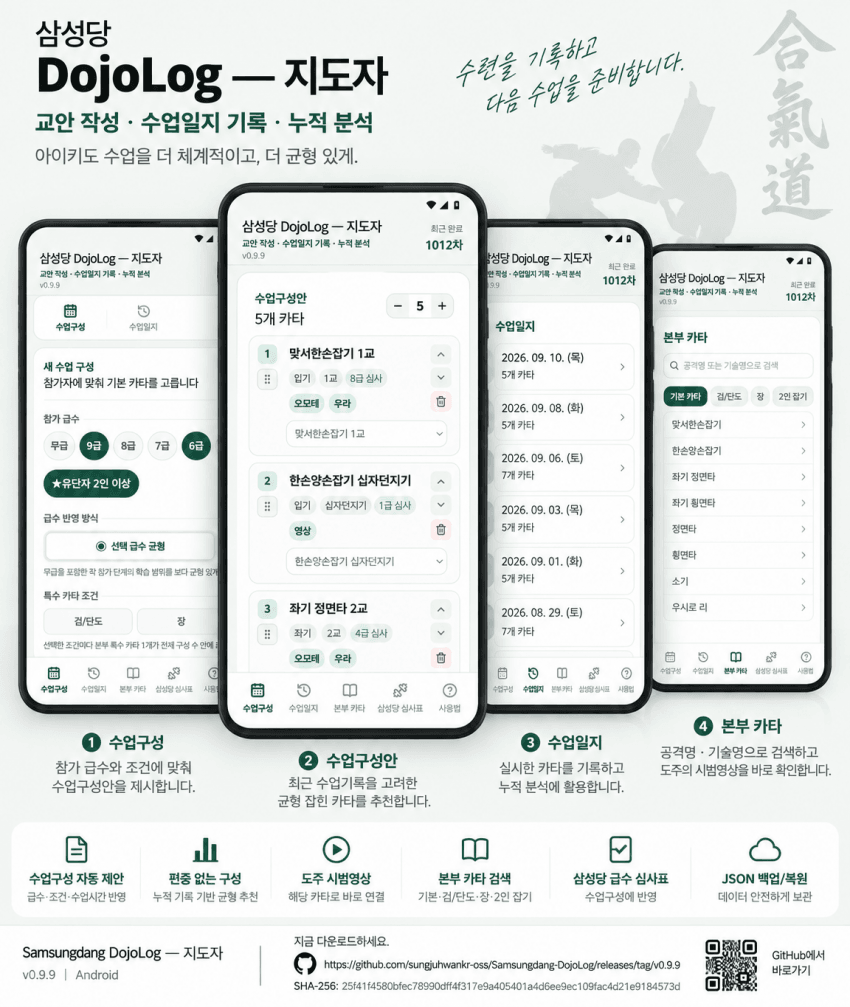
To celebrate the 1,000th class at Samsungdang, I went ahead and made an instructor app for myself.
It’s called Samsungdang DojoLog, and the current version is v0.9.9.
I started developing it to celebrate the 1,000th class, but it took a while to actually build and test it, so the counting of new class days in the actual app starts from Samsungdang’s 1,010th class.
■ Download
Samsungdang DojoLog v0.9.9
Android
GitHub:
https://github.com/sungjuhwankr-oss/Samsungdang-DojoLog/releases/tag/v0.9.9
Just download the APK file from the Assets section on the release page.
SHA-256:
25f41f4580bfec78990dff4f317e9a405401a4d6ee9ec109fac4d21e9184573d
■ Why I made it
As I kept teaching classes, I found myself facing the same worries over and over.
What kind of curriculum to do that day,
whether I’d been doing certain techniques too much lately,
or conversely, what techniques I hadn’t done in a while,
and considering the rank levels of the people attending that day, what range would be appropriate to cover, and so on.
I’ve been continuously keeping records of class days, so I decided that simply piling up these records wasn’t enough — it would be better to actually make use of them when preparing for the next class. That’s why I started building this.
■ Class Curriculum Suggestions
If you select the ranks of the members attending that day, the app suggests a class curriculum.
At Samsungdang, weekday classes are 1 hour, with 5 categories,
and Saturday classes are 1 hour 30 minutes, with 7 categories as the basic structure.
It’s not just random selection.
By referencing the saved class records, it’s designed to actively avoid categories that have been done frequently lately, and to prevent excessive bias toward any particular attack or technique.
If 2 or more black belts are attending, that condition can also be selected separately. In that case, one 2-person grappling category is added, along with a general category matching the level of the attending black belts.
On days when you want to practice with a sword or short staff (dan/jang), you can select that separately as well.
These categories aren’t added on top of the 5 or 7 categories — they’re included within the total class time.
For example, on a weekday
★ 2 or more black belts
+ sword/short staff
+ staff (jang)
if you select all of these,
2 general categories
+ 1 two-person grappling category
+ 1 sword/short staff category
+ 1 staff (jang) category
would result in a total of 5 categories.
■ Dojo Demonstration Videos
For categories that appear in the suggested curriculum, you can check the dojo’s demonstration video right from the app.
It’s a feature that lets you open the video right away when you want to review the basic form of a category while preparing for class.
Where possible, I linked directly to the specific timestamp where the category appears in a longer video, so there’s no need to search from the beginning. And in cases where you need to check both omote and ura separately, I made it so you can view each one individually.
■ Class Log
After finishing a class, you save the category you actually taught into the class log.
These accumulated records are then reflected when generating the next class curriculum suggestion.
So the more you keep using it, the more accurately your recent teaching history is reflected in the next recommendations.
At Samsungdang, record-keeping with this app starts from the 1,010th class.
■ Headquarters Categories / Rank Chart
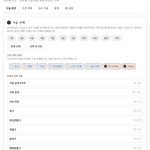
Separately from the curriculum builder, you can search headquarters categories by attack name or technique name, and also check that category’s dojo demonstration video directly.
Besides the basic categories, sword/short staff, staff, and 2-person grappling are also organized separately.
The current version also includes the Samsungdang rank chart.
Since the curriculum builder references attendees’ ranks and this rank scope, v0.9.9 is basically a version I made specifically for my own practical use at Samsungdang.
■ The Purpose of This App
I hope there’s no misunderstanding about this part.
The goal is not to have the app or AI decide the class content in place of the instructor.
Once the instructor sets the conditions for the attendees and that day, referencing the class records and technique balance so far,
“How about a curriculum like this today?”
it’s an assistant tool that suggests one such option — a class log plus class preparation aid.
The actual class can, of course, change depending on the condition of that day’s attendees and the instructor’s judgment.
■ For Now, Releasing v0.9.9
The current version is for Android.
Since I made this app for my own practical use in classes, the Samsungdang rank chart is fixed within it.
However, if other dojo instructors try it out and respond positively, I’m thinking of expanding it a step further for v1.0.
The v1.0 I currently envision would not use a fixed Samsungdang rank chart, but would instead let each instructor directly input their own dojo’s rank chart, and generate curriculum suggestions based on that rank scope.
If that happens, it wouldn’t be exclusive to Samsungdang anymore, but could become a general-purpose DojoLog that any dojo could use according to its own operating style.
However, I still don’t know whether this would actually be something other people need.
So for now, I’m releasing the v0.9.9 I’ve made so far first.
Please try using it yourself, and let me know things like:
– This kind of feature is useful
– This one isn’t really necessary
– It would be nice to have a feature like this
– It behaves oddly in a certain situation
I’d appreciate it if you’d share similar opinions with me.
Based on actual usage feedback, I’ll decide whether to develop it further into v1.0.
※ This is not an app registered on Google Play — it’s installed directly via the APK.
※ During installation on Android, a source verification notice may appear.
※ Data such as class logs can be backed up/restored as JSON. If your records build up, I recommend backing them up occasionally.
※ This is the first publicly released version, made personally by me. If you experience installation issues or errors on certain devices, please let me know along with your device environment, and I’ll look into it.






Wow!! Amazing~~
That’s really impressive!!
You’ve provided a tool that will be decisively helpful in converting tacit knowledge (which requires literally grasping the master’s hand) into explicit knowledge (a manual anyone can follow). Following a manual won’t automatically make someone a master, but systematic training in the fundamentals is surely the shortcut to becoming an “objective master”—one grounded in universality and validity—rather than a “master unto oneself.”