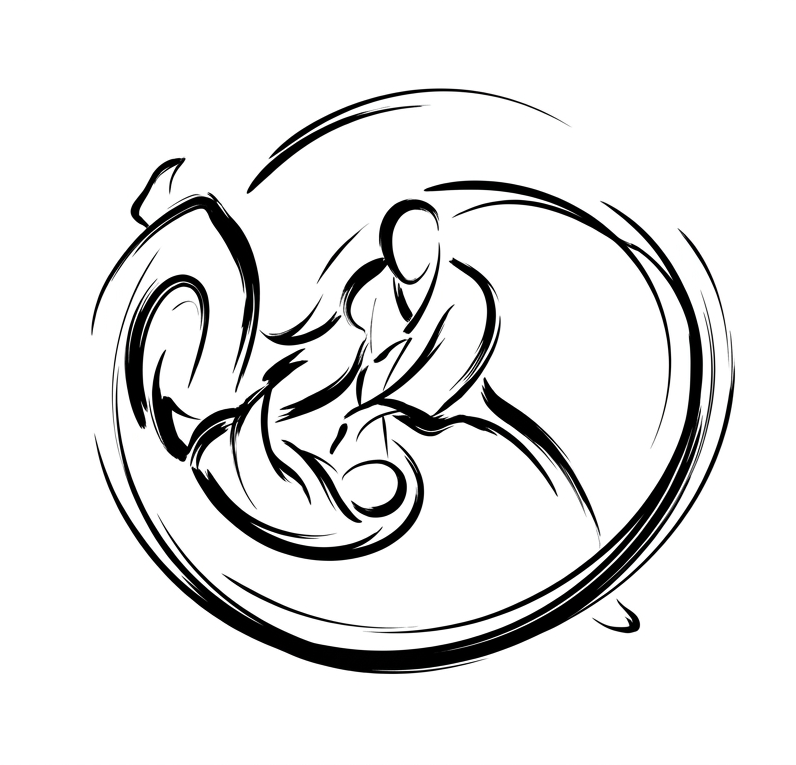
The Martial Way of Poetry(詩), Expressed Through the Body(武道) – Aikido(合氣道)
-The Substantive Harmony of Object and Subject-
Ryu Seong-hoon
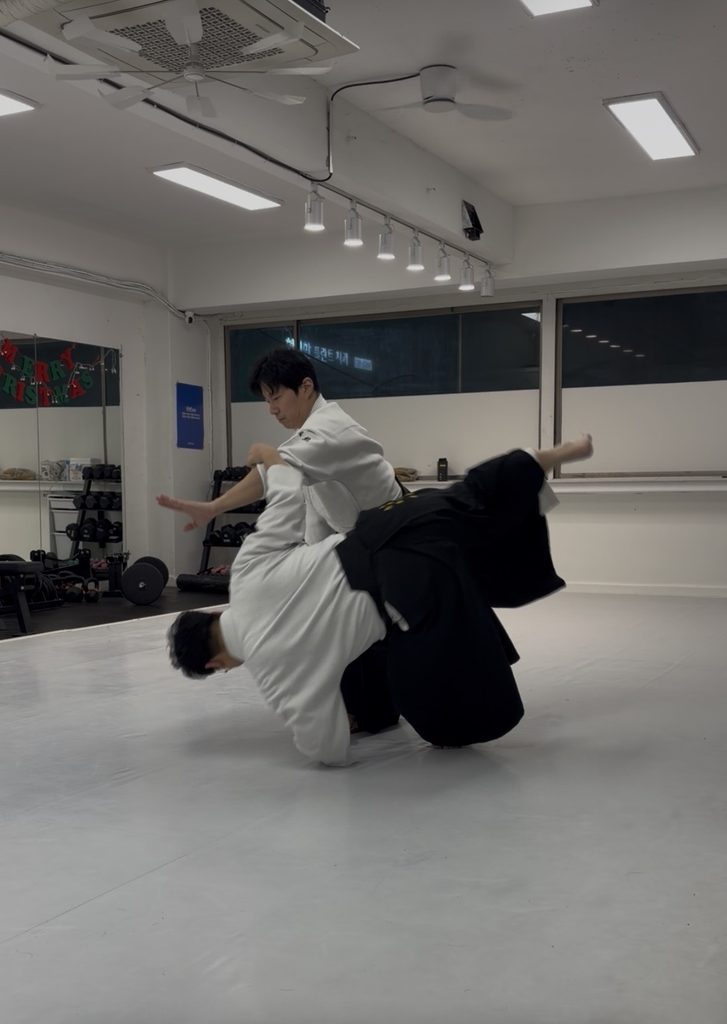
For a long time now, I have continued to harbor a fantasy that is neither particularly special nor ever likely to be resolved. And when I look back, I find that I am still living inside that same fantasy today. I sometimes think it could be a kind of compulsion related to life itself. I don’t know why, but ever since I was young, I have been driven by the desire to “find something worth doing even a little more than being a king, and devote my whole life to it,” and there has been no change in that way of thinking—I suppose it’s because I want to use the time I have been given, however limited it may be, to become a slightly more complete person. Since this is ultimately a matter of deeply subjective values, there may be no correct answer at all, but perhaps such musings can be of some help to those of you who are living out and cultivating your own particular worlds.
To give an example, it goes something like this. My major in college was modern literature, and within that, specifically poetry. Unlike most literary people, who tend to have made literature their ultimate life goal from the start, that was never the case for me, nor did I ever have anything like a lofty motive. When I took my college entrance exams, I applied both to a business economics program at one university and a literature program at another, and back in those innocent days, when I never dreamed the world would become the kind of survival-of-the-fittest hellscape it is now, I, then a high school student with no particular interest in literature, suddenly thought of it. And with the sheer, unshakeable logic that “you should do what you love in order to succeed,” I chose “literature” over “economics.” At the time, in the eyes of someone who liked literature but had no real idea what it even was, literature was simply “the art that deals with language,” and when I asked myself which literary genre I’d tasted in college dealt with language at the deepest level, my answer was, of course, “poetry.” That is the one reason I chose this path I’m still on today, and I have never once changed my field of study. Because I have the kind of personality that, once I decide something is right at the highest level, I simply trust it and quietly keep working at it no matter what it is, I’ve had no choice but to endure many hardships along the way, but I’ve never once wandered off course. Fortunately, I met wonderful teachers and seniors, and thanks to them I have been able to continue with literature up to now, but honestly, it could just as easily have turned out to be a truly tedious and uninteresting life.
Whatever the case, my compulsive choice, made through such a naive beginning, has fortunately turned out (as far as I can tell) not to have been a mistaken one, and I am still living according to that conviction. It is because, through literature, I am living in a way that allows me to be a little more honest with myself than someone who knows nothing of literature or has never engaged with it, and for that I am grateful.
When I was a frail child in the lower grades of elementary school, I was dragged along to the taekwondo gym on my father’s authority and became captivated by the appeal of the “martial way.” All the friends in my neighborhood, front and back, practiced the kind of “national fitness taekwondo,” and I wondered whether there wasn’t some more advanced martial art out there. Wanting, in the end, to learn a “weapons-based” martial art in the most human sense possible, I moved with a child’s naive heart and curiosity first to a gumdo (kendo) hall, then, finding that a way that let me truly master a single weapon suited me better, to a kendo hall, and I spent nearly the entirety of my adolescence together with kendo. But as I came to understand a bit more deeply about the history, principles, and advantages/disadvantages of kendo, I naturally came to learn about Japanese classical martial arts as well, and in the process I learned that, alongside kogusoku (the form of old-style swordsmanship best preserved to this day), there also existed martial arts that unleashed sword techniques through the body without any actual sword (剣). I sensed intuitively that this would resolve my thirst for a value more high-dimensional than the “modern kendo” of sportified competition, and I was completely won over. (This does not mean kendo’s historical authenticity is inferior—it simply means what it pursues belongs to an entirely different dimension.) Because of this, I eventually cleanly gave up the kendo I had practiced for so long, and starting from the thought that I would begin the study of “martial way” (武道) completely anew, I began training in—and continue to train in to this day—the martial art that is Aikido (合氣道). As you can see, the motive behind starting this hobby of mine was really no different from the motive behind choosing my major.
There is one thing that modern people greatly misunderstand. When we say “martial way” or “martial arts,” people commonly assume that the very meaning of the character 武 (mu), the root word, is “the technique of fighting.” There are many characters with meanings like “to contend” (爭) or “to fight” (鬪) that convey the sense of fighting against an opponent, but in fact, for people of old, these had no particular connection to the meaning of 武 (mu) at all.
The character 武 (mu) appears to have the character for “stop” (止) beneath the character for “spear” (戈). Since the spear was the principal weapon of ancient warfare, if we translate this literally, it comes to mean “to bring a fight to a stop.” In other words, for people of old, “mu” was not “a method for fighting” but rather “a method for either bringing a fight to an end or preventing it from happening in the first place.” There are also those who interpret this character as “the image of a warrior leaning a spear against a tree and sitting down.” Whichever the case, the meaning behind fighting is entirely absent.
And yet, at the very least in my experience, most of the dojangs where people today train in the martial way, and the instructors who train them, seem to teach students and adults only how “to fight” and how “to defeat the opponent,” and the demonstrations and shows they put on genuinely look like they’re obsessed with nothing but “winning.” That is an unfortunate matter for both the practitioner and the observer, but perhaps it’s also that the anxious and distorted atmosphere of a society that considers weakness itself a defeat is simply attaching itself to and reinforcing the phenomena of the present age. In such an atmosphere, I honestly could not understand how almost every dojang could shamelessly proclaim that it was providing lessons in courtesy and character education while running its business. What on earth is courtesy, and what is character, in a place where the moment students walk through the door, without even being asked why, they raise the national flag, salute it, and pit friends against each other, all so as to expend every ounce of energy just trying to win? Could such a thing really be considered essential character education? Or should we perhaps decisively cast off any illusion that such a thing is truly courtesy? I always had my doubts. As far as I could see, there was no philosophy anywhere of coexistence and peace in the sense of “you must live for me to also live.” Naturally, I never once witnessed the will, let alone the attempt, to share and practice even that bare minimum. This was all, I believe, due to the shallow understanding that sees only the surface appearance of “mu” (martial) without perceiving its true essence within. And yet, this martial art was different.
“Aikido, a method of harmonizing energy, is a spiritual training method and also a military discipline developed by Japan’s Morihei Ueshiba, who lived through an era much like the one Gandhi lived through. He gained his enlightenment through a process of understanding that all creation and the self are one. And in stark contrast to nonviolence and pacifism toward enemies, he created an effective method of self-defense. Whereas Gandhi applied the spiritual ideals of patience, courage, and love to large-scale political struggles, Ueshiba applied them to smaller-scale, personal conflicts. Ueshiba’s genius lies in the fact that, by developing a series of practical movements and countermeasures, he created a method by which each individual could bring nonviolence to life in practice.” (from “A Discovery of Great Thought,” Michael Gelb, October 5, 2007)
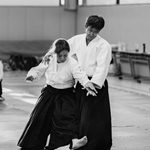
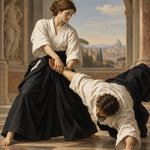
The above passage is part of a humanities book introducing the thoughts of some of history’s greatest geniuses, and in the section discussing Gandhi, the author compares Ueshiba Morihei to Gandhi while introducing Aikido. It briefly and clearly explains the key features of this martial art, so I’ll add a bit here as well. Unlike our own country, where the origins, history, and founder are unclear, in keeping with the characteristic feature of Japanese martial arts, which have their traditions passed down clearly centered around a lineage, Aikido is a representative training method that its founder, Ueshiba Morihei (1883–1969), created based on classical martial arts, and it is now a modern martial art and training method widely practiced by people all over the world. Having witnessed the tragedy of many wars and killing, including the horrors of the two World Wars, he took the principles of classical martial arts such as jujutsu, kendo, and spear techniques that Japanese warriors of old had practiced, along with the fencing and old-style “Daito-ryu” jujutsu he himself had long trained in, and grafted his own pacifist thinking onto this unique jujutsu that manipulates the body through sword-like movements. Unlike other martial arts aimed at suppressing or killing an opponent, this made it a new, humanistic pilgrimage, and it eventually became a discipline that is distinctly and vastly different from the content typically referred to as “martial arts” in general. Aikido is a modern martial art, and at the same time it may also be the martial art that best preserves the forms of old Japanese classical martial arts, but the interesting point is that it is founded on the consciousness of protecting oneself from an opponent while, at the same time, also protecting the very opponent who tried to harm you, without either side sustaining serious injury. This martial art—expressed in the body through the idea that peace is not about killing you so that I may survive, but rather is achieved by embracing the opponent’s whole self, so that “you and I living together is itself peace”—was enough to give me, an ordinary person who had only ever understood martial arts as combat techniques, a fresh shock.
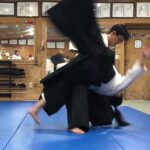
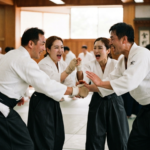
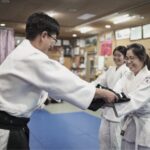
Perhaps precisely because that philosophy itself is founded on the idea of peace, the movements of the body are extremely gentle and fluid. And while the flashy displays of technique and grappling are teachable, clearly defined techniques, since each person’s build and strength center differ, one has to go through a thorough process of repeated actions built up through long training experience and a keen sensibility for reading and matching the opponent’s energy. It is difficult and profound—and also, for that very reason, interesting—in that one must ceaselessly raise one’s own level. There are also very important techniques for striking the opponent with the hands, called ateme (当身技), but these are only trained as a means for understanding and explaining the principles and completeness of a technique, and it is interesting that they are never used as a means to actually suppress or injure the opponent. Because of this, even people without strong physical strength or muscular power can train in it for a long time, and the training atmosphere is also very amicable and comfortable. It is also, without question, a wonderful martial art for women to practice.
They say Aikido aims for peace, but that does not mean its techniques lack power. No—on the contrary, it is powerful enough to be genuinely brutal in practice. If, using only the basic techniques of Aikido, one were to apply a technique against an opponent while maintaining hostility and using force in an unbalanced way, several joints could be dislocated at once. On the other hand, if one enters accurately and cleanly, even a large opponent can be brought down easily. Of course, since nothing worthwhile in this world comes easily, it is important to keep practicing repeatedly in order to deepen one’s technique, and one should train only in a manner that neither injures nor pains the other party. It demonstrates, through embodied practice (體術), that once one has attained sufficient strength and dignity, mutual respect and, hence, peace becomes possible.
The most interesting aspect of Aikido, as I’ve come to feel it, is that it occupies a middle ground between the martial way (武道) and thought/ideology (思想). Aikido resolutely resolves what might, on a superficial hearing, seem like a contradiction between the two. While it is founded on combat techniques, it guides one not to “fight.” It also espouses a peaceful “ideology,” yet it remains a training method rather than a philosophy. This point brings an important fact to light.
For the most part, in our society, many of the values we learn are cases where there is an especially severe gulf between theory and practice. For instance, even though law students and legal scholars major in law and dream of realizing social justice, diligently studying the constitution, commercial law, criminal law, and so on, and go on to become lawmakers, in reality the law is often so shabby and powerless, and its contradictions so glaringly obvious, that it seems almost a joke. When I studied literature in college, it was no different. To cultivate the ability to write good prose, I studied the history of literary thought, learned rhetoric, and studied numeracy, but despite all the academic disciplines needed for literature, what is truly required in order to write a good work is the “depth of thought” with which one looks out at the world through one’s subject matter—not the complex study of literature or elaborate mathematical formulas.
Nor is the situation any different when children learn taekwondo from an early age. Though there exist a wealth of techniques and forms containing all the principles and advantages/disadvantages of taekwondo—things like the poomsae required for national demonstration teams, including Taegeuk forms 1 through 8, the Koryo, Geumgang, Taebaek, Pyongwon, Sipjin, Cheonkwon, Jitae, Hansu, and Ilyeo forms—and while people diligently memorize and train in these, when it comes to actual sparring situations or real-life situations, it seems that among all these, no technique other than quick, fast counterattacks ever really gets used.
Based on what I have seen and learned so far, insufficient as my own training may be, Aikido places great importance on the relationship, or the “distance” (called ma-ai, or 間合い, “interval-fit”), between the opponent (the object) and myself (the subject), and it is a martial art that pursues harmony (和) by enabling the “energy” (ki) present in that relational realm to be used in a peaceful and desirable way. And so, naturally, contact with the opponent occurs, but it is only natural that both parties avoid getting hurt. This is not the theoretical, academic, so-called armchair peace and harmony that merely “sounds nice” at the abstract level, but rather has as its aim the realization of a more direct kind of peace through effort that demonstrates that true harmony is possible even at the individual and material level between object and subject. I think it is not without reason that this is precisely what has secured Aikido’s place as the most outstanding and excellent of modern martial arts.
This point is decidedly philosophical, and also artistic. The reason we say, upon seeing something truly beautiful, “Now that’s really art!” is because we feel it is beautiful on some level. Aikido’s movements and the flow of the body are, in appearance, beautiful, and they represent, perhaps, the most “balanced” form the human body can express. And yet those who practice it alone, quietly perfecting the movements of their own body, never boast, “This is a wonderful thing.” Rather, since it is achievable only through the mutual relationship of two people and the mediation of their forces, that harmony can be all the more genuine, without any need for explanation. It is also remarkable that the reason such body movements emerge is, as mentioned above, philosophical—that they are the result of peaceful thought. I don’t know if this point stands out to others, but I think it has a strong connection to literature.
Literature exists on the boundary between the dimension of “scholarship” and the dimension of “art.” Literature is neither the study of Chinese classics nor aesthetics, but rather a field of art whose results can only be produced when every kind of philosophical contemplation and its foundations come together as one. If the value in service of humanity’s deep and lofty contemplation is “philosophy,” then the value for elevating and honoring the highest beauty expressible is “art.” The concept of literature, in fact, exists somewhere between the two. Simply put, if literature is the means by which the “deep” contemplation of the spirit, or the world beyond it, is refined through an object and expanded and expressed in beautiful language, then Aikido does not seem so different from a work of exquisite art from a long-gone era that displays, through harmony with an opponent, the sublime value of “peace” made beautiful and formalized rationally, on a physical dimension. And the starting point of these two forms of cultivation both lie in the “relationship” between self and other (or the opponent).
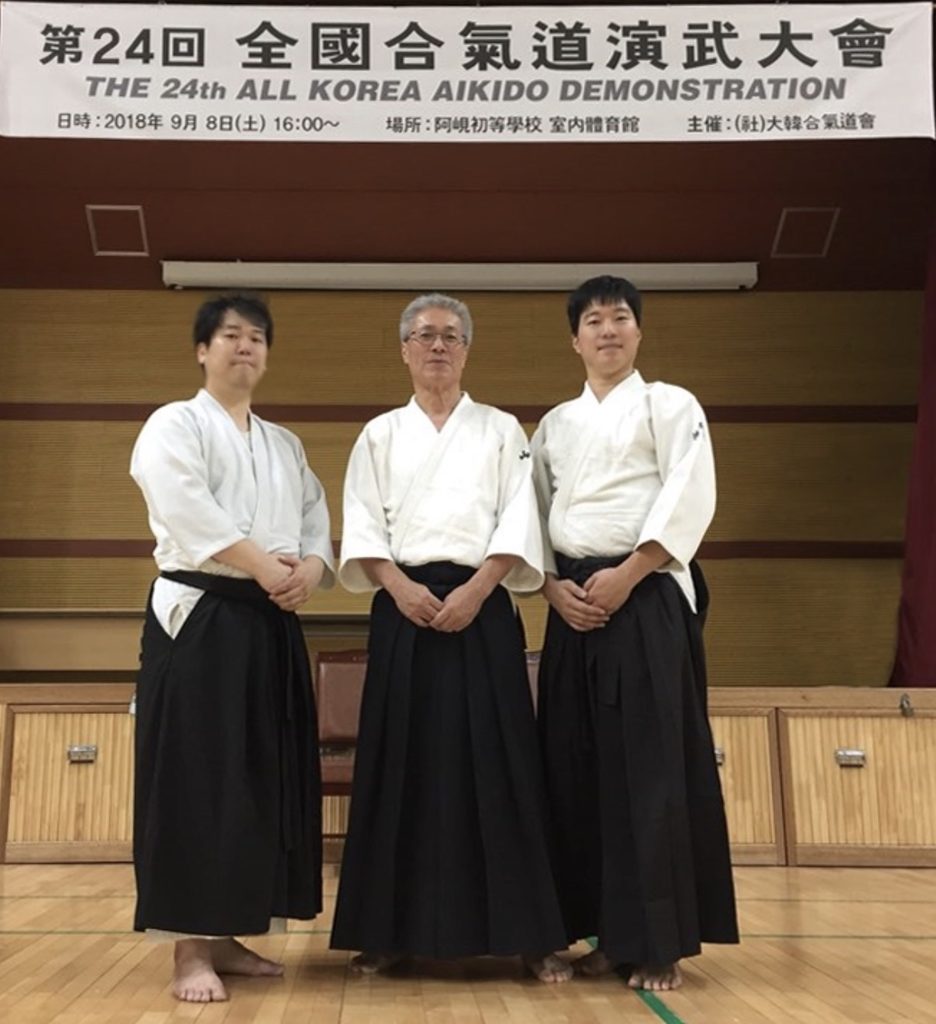
As Sartre spoke of in existentialism, we live within the fundamental predicament that we can never sever the existential distance between object (thing, other) and self. That is precisely why, in our lives, fighting, confrontation—these arise ceaselessly and without end, friction occurs, and all manner of negative factors—sadness, anger, internal and external conflict—begin from that very point. It is self-evident that we can never become one, and that as long as we remain finite beings possessing a body, we can never see a world beyond that duality. To put it simply, philosophy affirms the existence of that transcendent realm, while art is the value found at the very forefront of the endless effort to arrive there. Literature reproduces that effort through language, while Aikido reproduces it through our bodies. Seen from that angle, Aikido seems to clearly possess, as an artistic martial art, the characteristics of an artistic context similar to literature. The only way we—an opponent and I, who can never become one—can nonetheless be made to become as one is through “harmony.” Literature pursues that through the harmony of language with language, and Aikido pursues it through the harmony between the opponent and myself—it is at this point that the two converge.
Finding what one loves in life is important and precious work, without exception. I happen to have taken up several such pursuits early on, and while these are indeed hobbies, I also think they may simultaneously be something inevitable. I wonder if the reason is that literature and Aikido share certain similarities.
A martial art of peace that pursues the organic harmony between me and the object, which can never truly become one in an existential sense. Because I am practicing a martial art that carries this “artistic” value—striving to bring you and me as close as possible to becoming one, and through that, protecting both you and me—I feel, just as I do through studying literature, ever fulfilled and happy. I believe that the true nature of “beauty” is hidden within the harmony of language with language, subject with object, self with other, and so I believe that even those who know nothing of literature or art can, through this training, also find that value of beauty. It’s just my personal view, but I also think it would be all the better if, among us poets, there were more people—not just myself—who could share this together with their own lives.
(Poet. Current Head of Deokyang Dojang)
- Since this is 2015, this piece was written over 11 years ago, so please forgive the writing, given that both my understanding and my own abilities were lacking at the time.
This was pulled up from an old blog post to promote enthusiasm for the activity, and administrators and members of the goinmul (regulars) community, please pass by this rambling piece with a smile. ㅎㅎ





It’s just amazing that Aikido can be explained in such a cool way!!
Really enjoyed reading this great post.
Enjoyed reading this, Seonghoon. You wrote it really well (not cringe at all, haha). I’d actually been waiting for your next post to show up, so I was happy to read it. In particular, the point about aikido standing between martial arts and philosophy, and the affinity between literature and aikido, really struck me.
“Philosophy presupposes the existence of an ideal realm, and art is the value that lies along the line of endless effort to reach it. Literature reproduces that effort through language, while aikido reproduces it through our bodies. In that sense, aikido is an artistic martial art, and it clearly seems to share the same kind of artistic context as literature.”
As a fellow literature major, it seems like I too had been unconsciously feeling the beauty of both aikido and literature at the same time, just like you. Looking forward to more great posts from you~!
I really enjoyed reading this, as it seems to set straight the perspective on why Aikido is an art and why it should be an art. The phrases “the existential distance between object and self” and the “inevitability of harmony” left a deep impression on me. As someone who cherishes Aikido, I sincerely thank you for presenting a “direction for beautiful Aikido” ^^