
Sometimes, when you teach Aikido almost every day with the same group of people, training can become repetitive.
At times like that, I often found myself wondering, “Hmm, what should I do today?”
So I made this. I didn’t get to use Sung Ju-hwan Dojang’s app, but the content I found there was a great help in creating this. I’d like to take this opportunity to express my thanks.
Based on the exam curriculum, I created a planner that randomly generates techniques by rank and exam techniques, and allows you to keep training records.
It runs on the web and was designed to be comfortable to view even on a mobile screen.
Clicking the menu “Level Up on My Own” opens the Aikido training planner.
The basic menu of the training planner consists of Today’s Training / Weekly Plan / Exam Techniques / Statistics / Settings.
1. Today’s Training
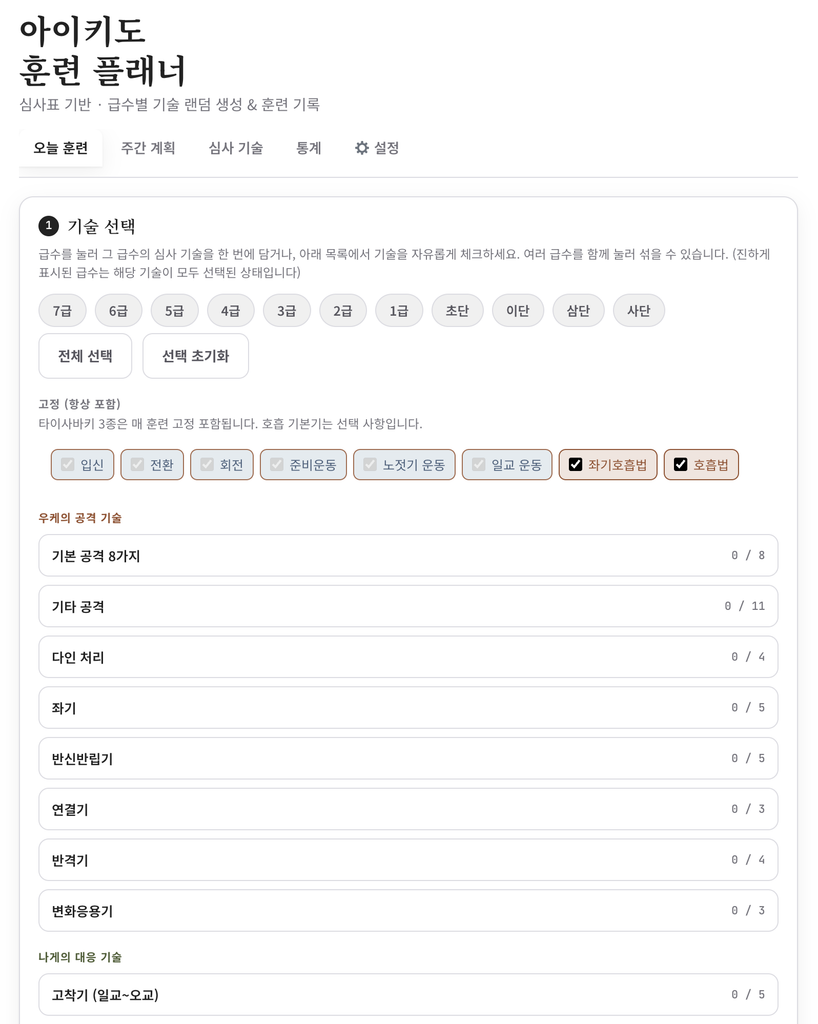
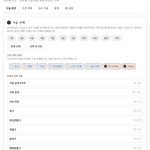
If you select “Today’s Training,” you can choose your rank, and you can also manually select attack techniques and corresponding techniques.
If you select a rank, the attack techniques and corresponding techniques based on the exam chart are automatically selected, and when you click “Generate Today’s Training” at the bottom, only the number of techniques you selected among the selected techniques will be displayed randomly.
If you select “Today’s Training” after manually selecting without choosing a rank, only the techniques that appear on the exam chart will be displayed.
For example, if you select all 8 basic attacks and all 5 pinning techniques, then click “Generate Today’s Training,”
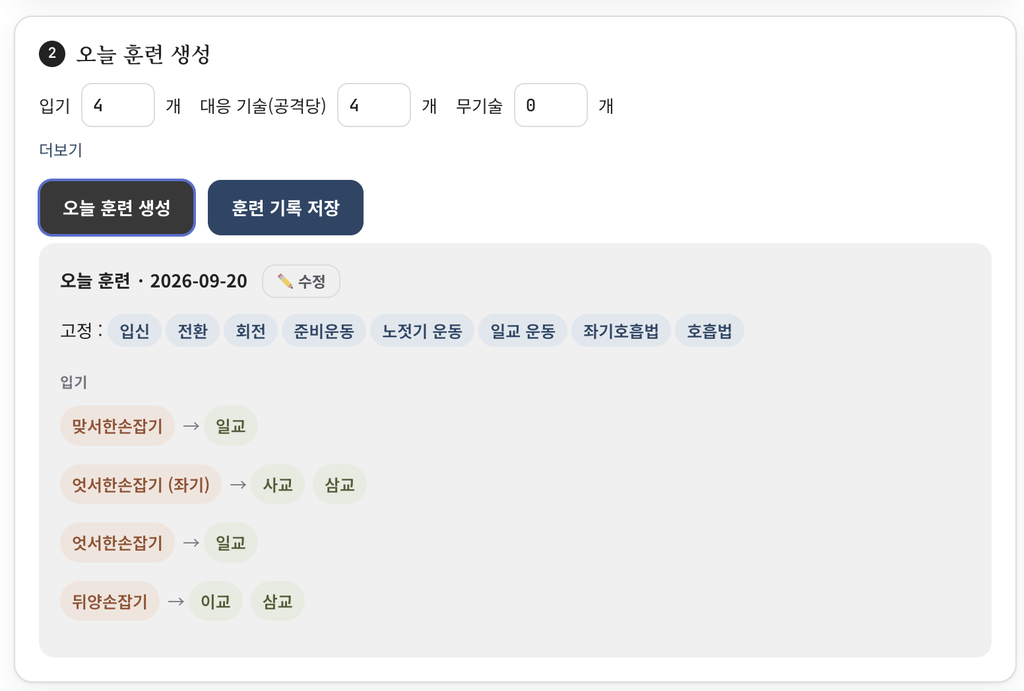
As shown in the picture, this is because only the techniques that appear on the exam chart are matched. In this case, if you click the refresh button, all attack techniques will appear, but if you click all the corresponding techniques for the attack technique you want to practice and then generate today’s training, it will be displayed as shown below.
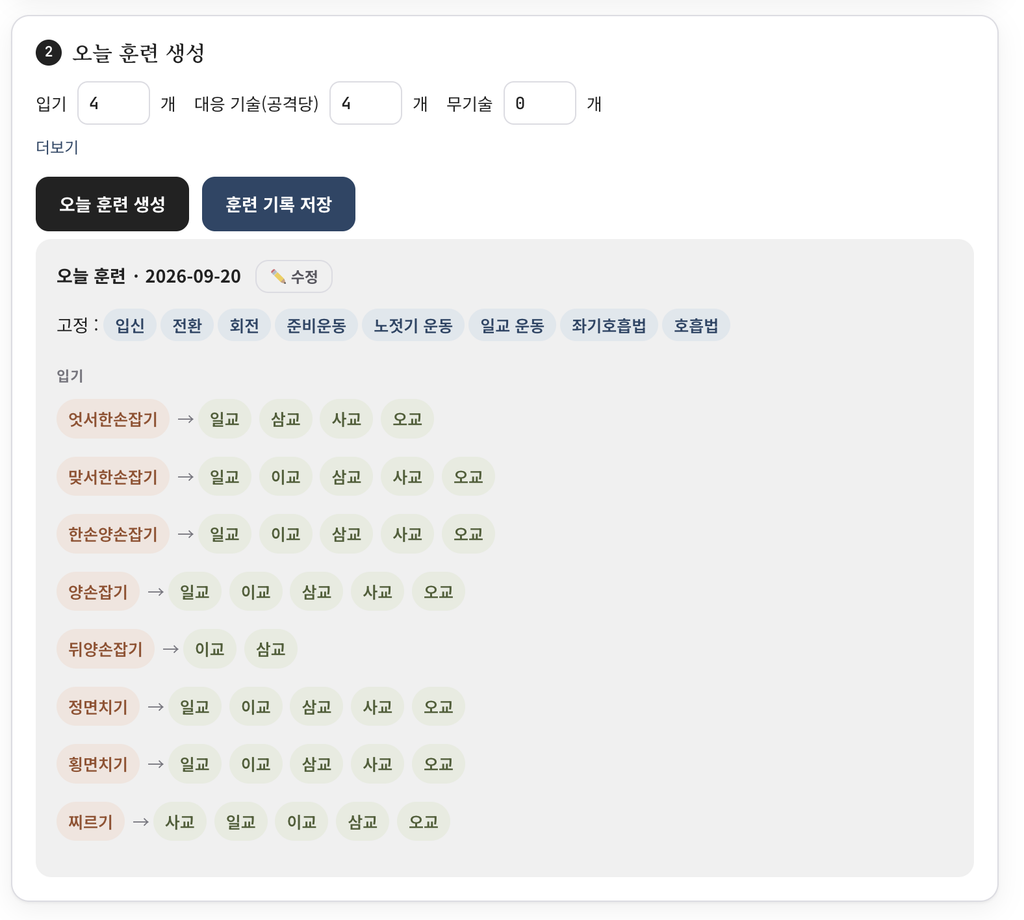
If you click “Save Training Record,” it is compiled into statistics along with the date and time saved.
All techniques are designed so you can add a video to view.
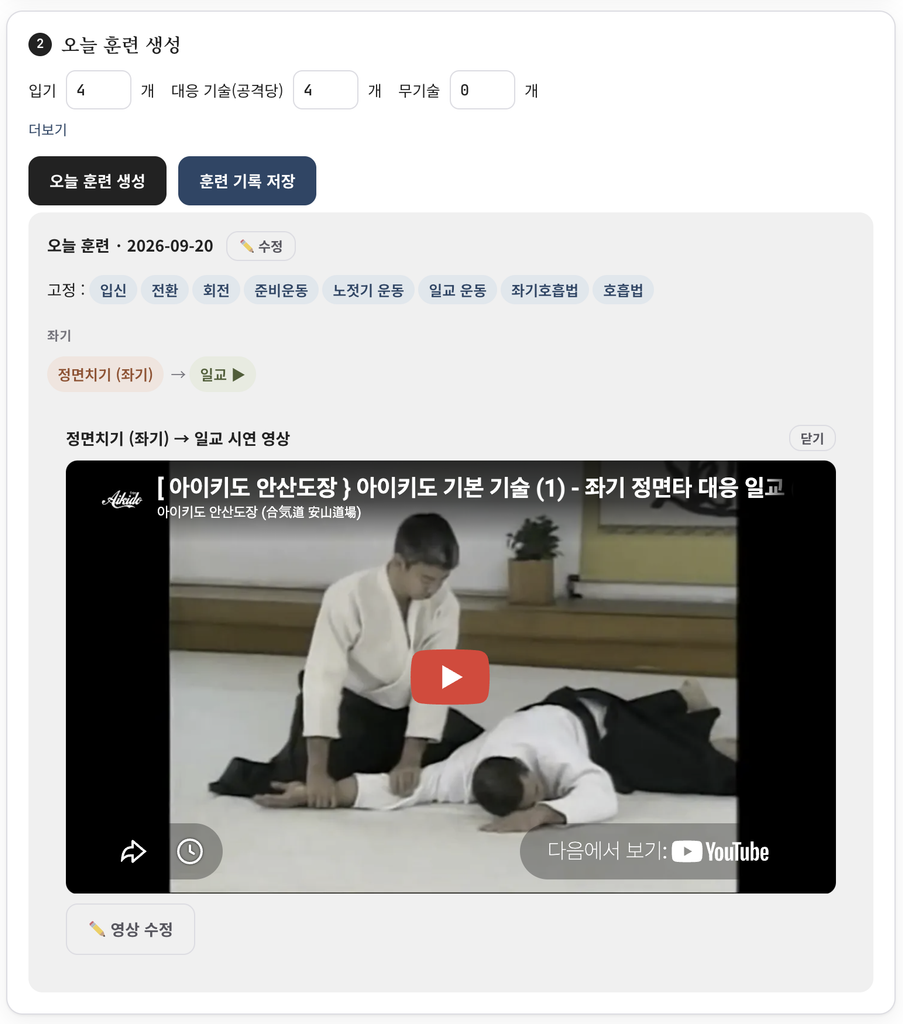
Videos can only be registered by the corresponding instructor or dojang leader, and are stored separately for each instructor or dojang.
A video registered by Instructor A will not be visible to Instructor B.
Basic videos are scheduled to be uploaded by the administrator, and each instructor can either revise them with their own video or view the basic video.
2. Weekly Plan
The Weekly Plan is exactly what it sounds like — a feature needed for setting up a weekly training plan.
I added this feature because I thought it would be needed for dojangs that run children’s classes or post weekly training schedules.
You can select the days for the weekly training schedule, and if you specify a date for Monday of this week, a weekly plan is generated for each selected day.
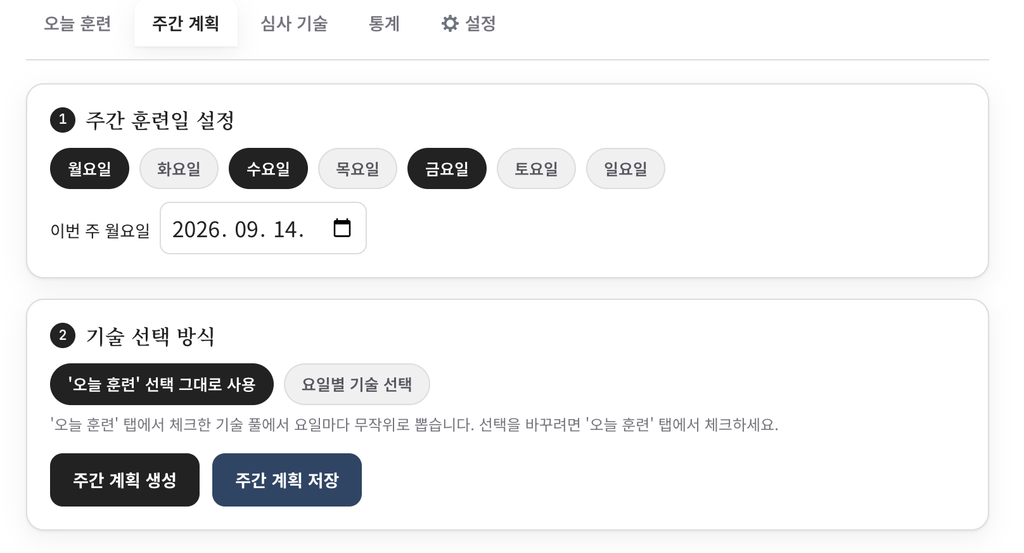
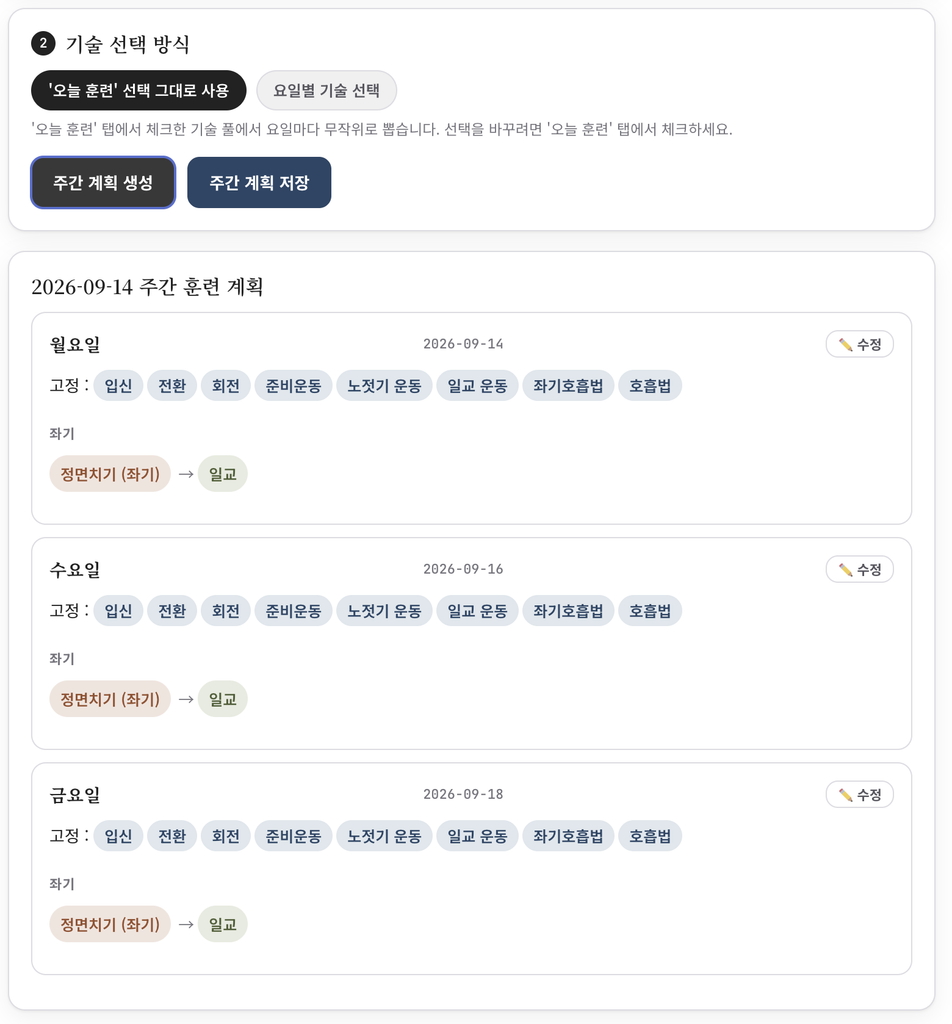
When creating a weekly plan, if you select “Use Today’s Training Selection As Is,” a weekly training plan is established using exactly the content checked in Today’s Training.
If you click “Select Techniques by Day,” you can use techniques by rank for each day, as shown in the picture, to generate the plan randomly.
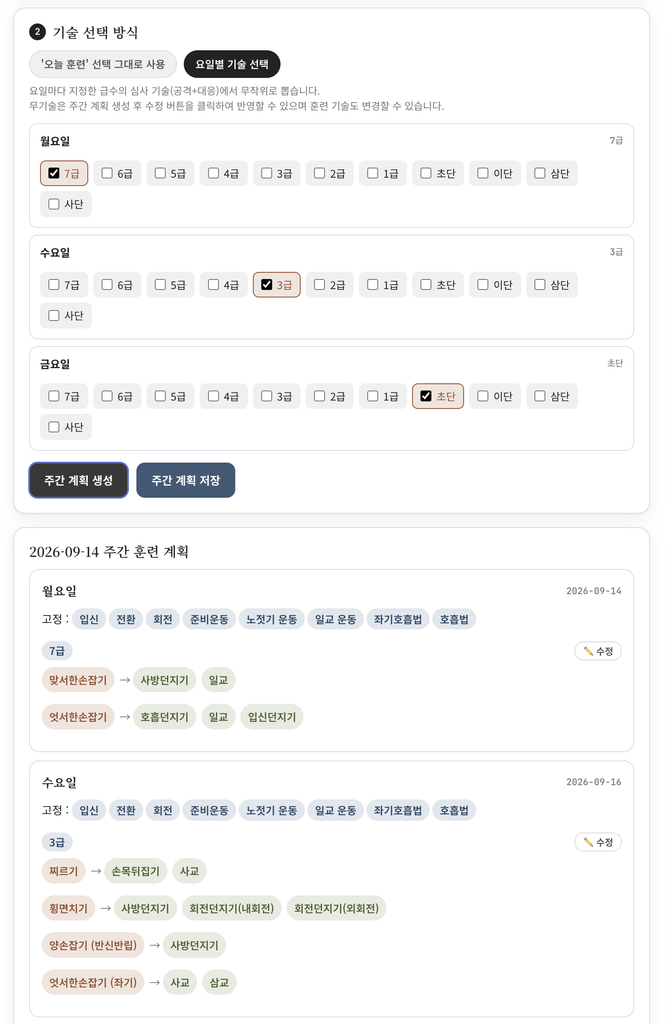
Whether you generate the weekly plan by selecting “Use Today’s Training Selection As Is” or by selecting “Select Techniques by Day,” every plan has an edit button, so after clicking it, you can add or change the training content and apply it.
If you click “Save Weekly Plan” here as well, it will be applied and reflected in the statistics.
3. Exam Techniques
For Exam Techniques, the exam technique chart is generated randomly, either through automatic composition by rank or by direct selection.
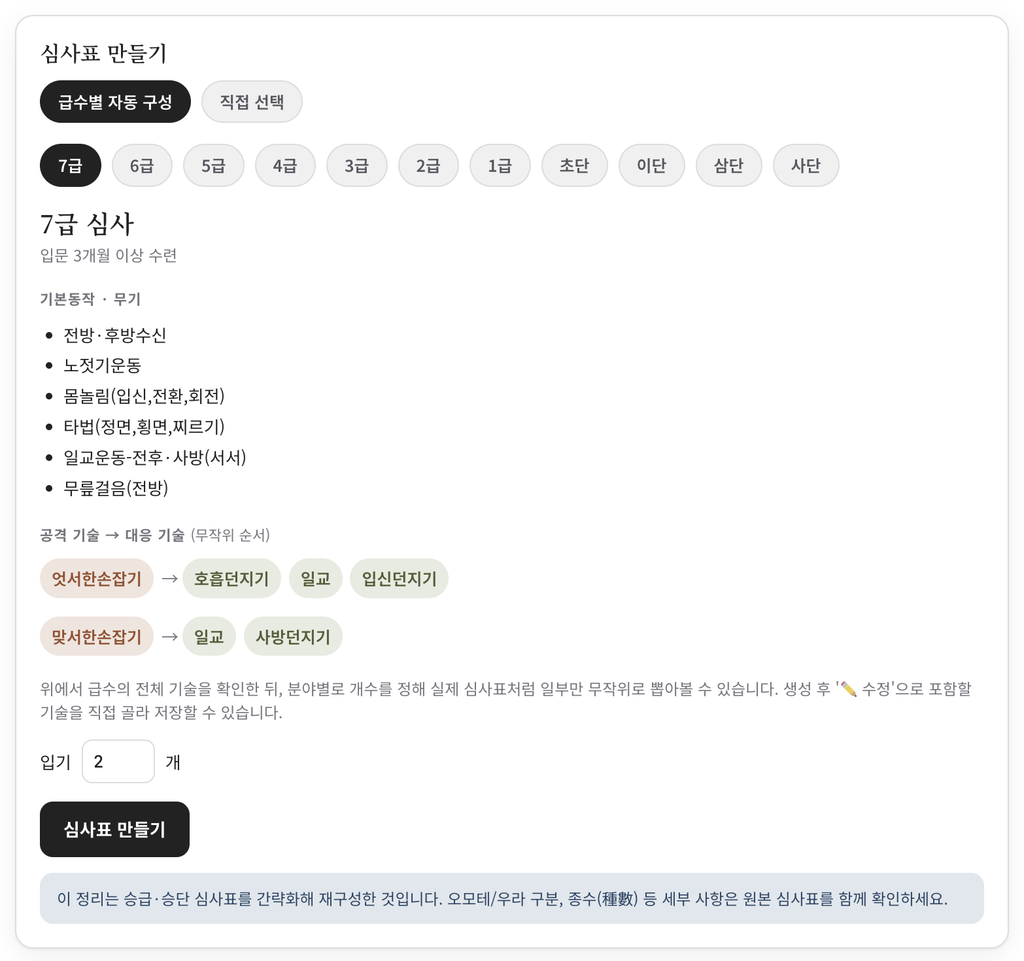
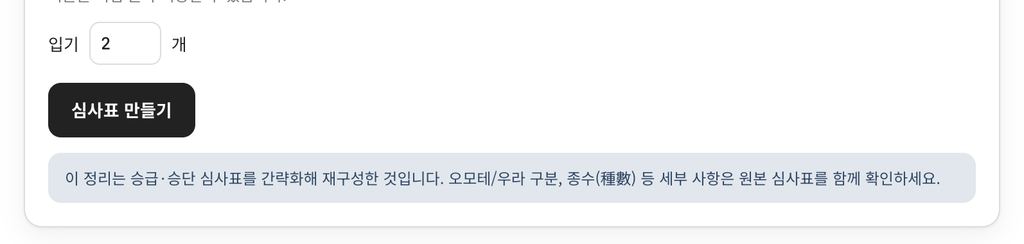
When creating the exam chart by selecting a rank or unit, you can enter numbers, such as 0 entries or 0 seated techniques, as shown in the picture below.
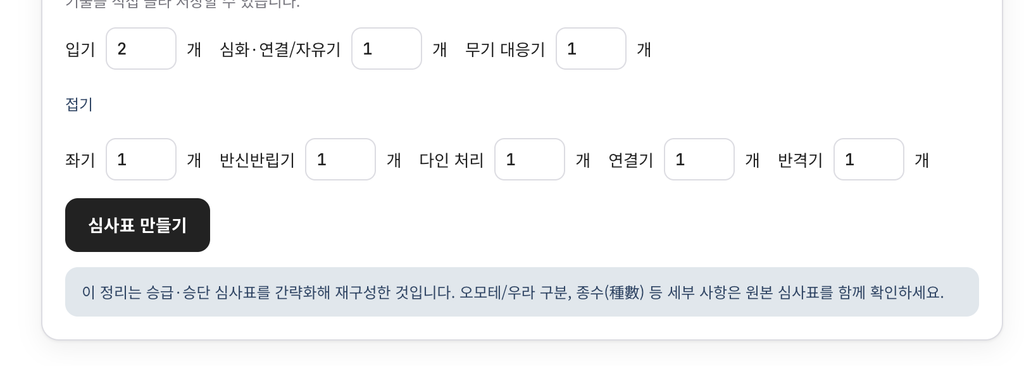
At this point, as many attack techniques as the number entered will be displayed, and by clicking the edit button, you can add or remove exam techniques.
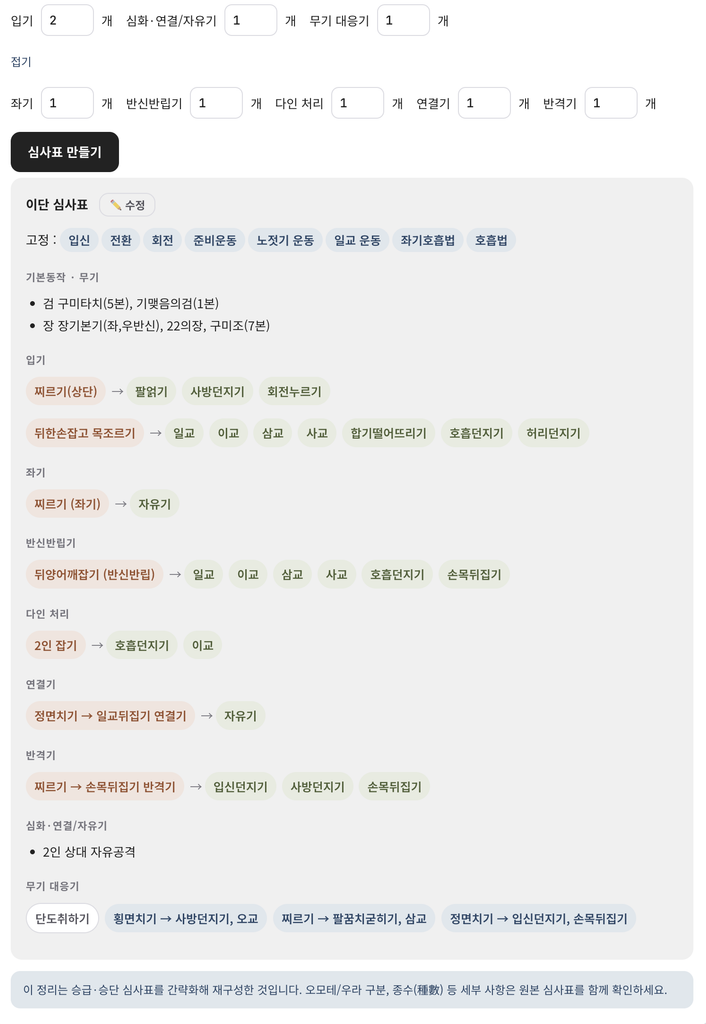
For exams, basic movements and weapons are always displayed by default.
I plan to make it possible to add, remove, or change these as needed.
4. Statistics
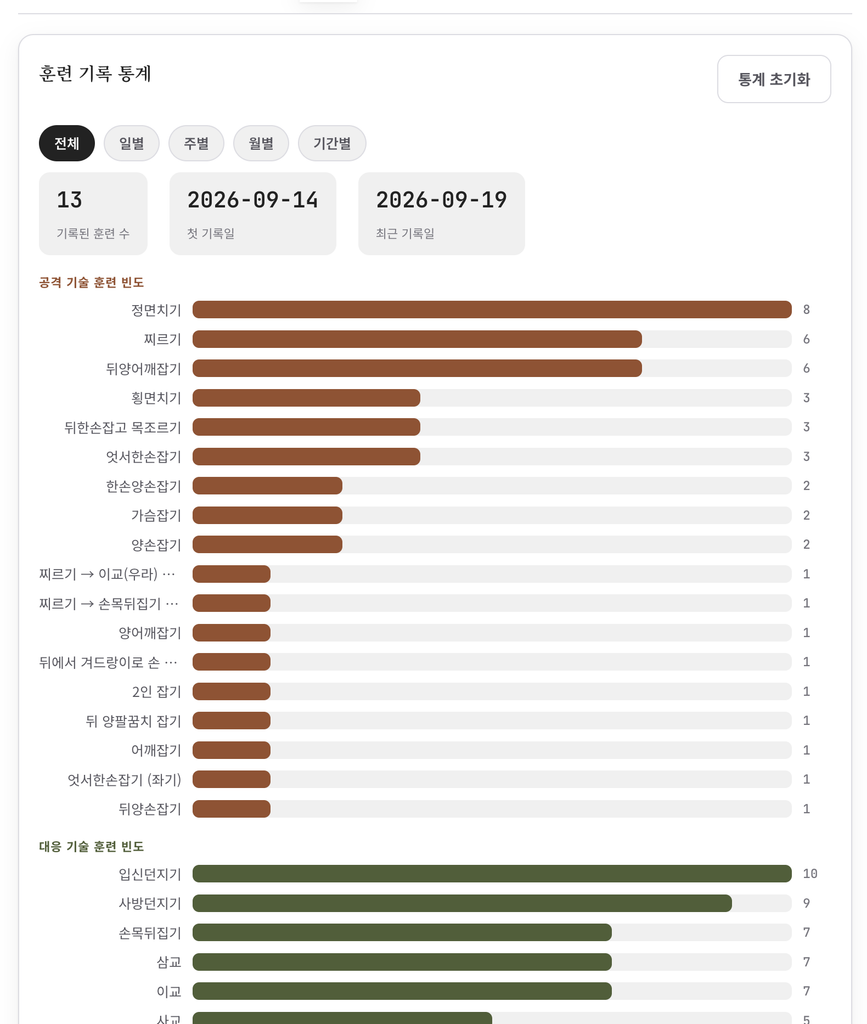
Statistics can be viewed as a whole / by day / by week / by month / by period, and are randomly used for today’s training, focused on the techniques shown less frequently in the statistics.
It is designed so that as time passes, techniques can be trained more comprehensively overall.
5. Settings
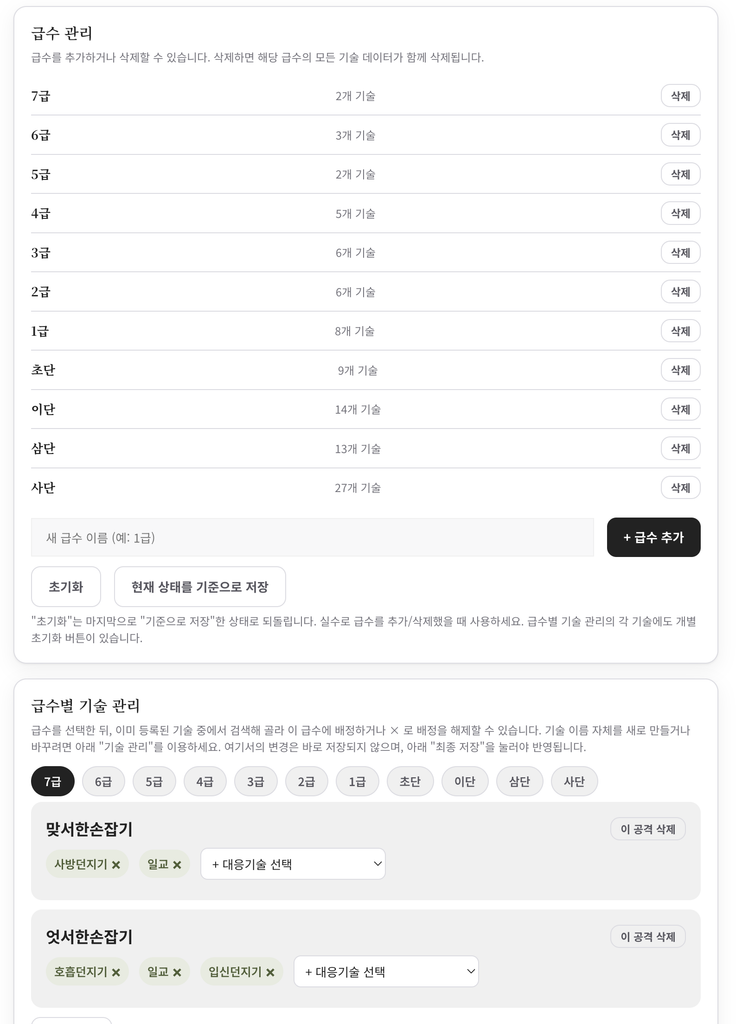
The Settings menu is only accessible to instructors at the dojang-manager rank or above who have registered a dojang.
You can manage ranks and manage techniques by rank.
Rank management allows you to delete or register exam ranks.
Technique management by rank allows you to add or remove techniques for that rank.
Changed content applies to the promotion techniques of that specific dojang and does not affect the promotion techniques of other instructors or dojangs.
When read in writing, it may seem complicated, but once you actually try using it, it’s not complicated at all.
While working on this, I already knew that Aikido techniques were vast, but actually trying to convert it all into writing, I once again realized just how enormous it truly is.
There are likely many parts I’ve missed while working on this alone.
If you try using it and find anything inconvenient, please feel free to leave a comment on the board.
For example, if you set up a plan by rank, the techniques will match exactly as shown on the exam chart, so there won’t be any issues with the techniques themselves. However, if you set up a plan by manually mixing and matching various techniques, some combinations that don’t actually match may appear.
Example: Rear Wrist Grab -> Kote Gaeshi (this is just an example — I’m not entirely sure whether this combination would actually come up)
If such combinations appear, please leave a comment on the board at that time.
Please include the technique name when reporting it. If you just tell me “it doesn’t match,” I won’t be able to find it.
I would greatly appreciate your interest as this planner continues to be perfected, and I hope it will be helpful for running your dojang.





Oooh~~ Amazing~ It’s getting more and more systematic. I can’t say a rough, unstructured approach is always bad, but there’s absolutely no reason a systematic education system would be bad either.