Written in November 2019.
■ Training in the morning, learning in the process
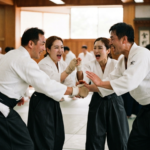
The Jeju Aikido training hall holds morning practice three times a week, on Mondays, Wednesdays, and Fridays. Morning sessions are mostly attended by people who have a hard time finding time in the evening. Those working part-time shifts, and those whose jobs require them to work in the evening, come to the training hall before starting their day to prepare both body and mind.
Morning practice comes with one condition: most members have to head straight to work right after training ends. That’s why, instead of high-intensity training that drains all one’s physical strength, morning sessions tend to focus more on a “learning-style” of training—slowly working through each movement one by one and understanding it. Exercising too strenuously could leave one exhausted for the rest of the day’s work.
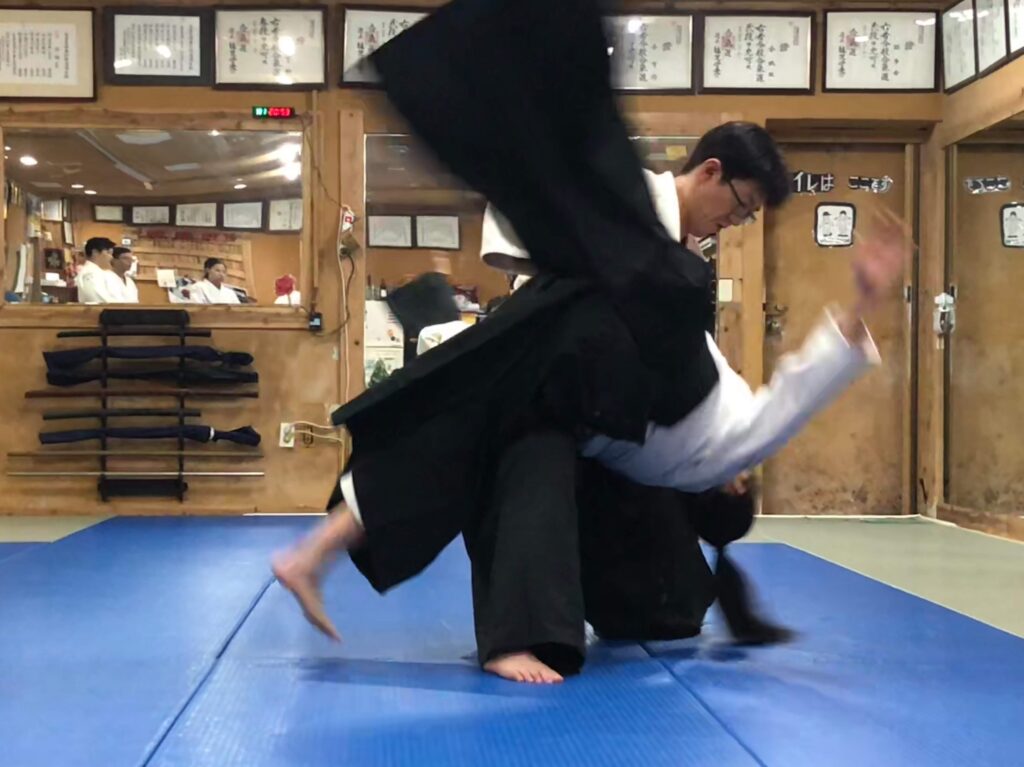
Today’s session covered ukemi, commonly known as break-falling. Ukemi is the technique of falling, rolling, and keeping one’s body safe. It looks simple to watch, but in reality it’s an extremely important fundamental skill that forms the basis for all training, no matter how advanced.
■ The wall called “the body’s habits”
Practicing ukemi often reveals an interesting phenomenon. The more experience someone has with other sports or martial arts, the harder it is for them to break out of the style they’ve grown accustomed to. Movements repeated over a long period of time have already been deeply etched into the body, so even when trying to move in a new way, the old habits unconsciously slip back out.
People are usually well aware of this fact themselves. So they consciously try to correct it. But the moment they actually roll on the mat, without even realizing it, the practiced motion comes out first. The head knows, but the body doesn’t follow, leaving them frustrated and struggling.
Consciously controlling a movement that comes out unconsciously is far more difficult than it sounds. And this is precisely where the essence of what Aikido pursues lies.
■ A martial art that tames aggression
One of the distinguishing features of Aikido is that it controls the aggressive tendencies that everyone possesses.
Typical martial arts training can be described as a way of harnessing the aggressive or defensive tendencies that surface unconsciously to match the opponent’s movements, protecting oneself by attacking the opponent. Striking arts are typically characterized by movements that counterattack after evading the opponent’s attack, while grappling arts show movements that respond to the opponent’s attack by throwing them down or locking a joint to subdue them.
Aikido, however, takes a slightly different path. It harmonizes the aggressive or defensive tendencies expressed unconsciously with the opponent’s movements, ultimately aiming to render the opponent’s attack meaningless. The goal isn’t to defeat the opponent, but to make the opponent’s attack itself lose its meaning.
For this reason, Aikido techniques can sometimes appear unrealistic, almost idealistic in their movements. And it’s precisely because of this idealistic quality that many people doubt Aikido’s practicality. But those who have experienced it firsthand, even just once, cannot help but be amazed by the movements of Aikido, which are built on rational and scientific principles.
■ Controlling instinct
Aikido is a thoroughly defensive martial art.
Rather than matching the opponent’s attack with an equally aggressive attitude to subdue them, one works to control the aggressive impulse that arises instinctively in order to protect oneself, and further, to protect even the opponent who is attacking. This is a unique characteristic of Aikido that is difficult to find easily in any other martial art.
Of course, expressing this characteristic through actual movement is never easy. Being attacked by someone is not an everyday occurrence in the first place, and in such a situation, protecting even the person attacking you is all the more far from ordinary. Yet in that very moment, without even realizing it, the impulse and instinct to forcefully strike and subdue the opponent arises.
When one instinctively harbors hostility toward another, that hostility ultimately leaves a wound on the other person, whether physical or emotional. We clearly know in our minds that this shouldn’t happen. And yet we still end up saying and doing things that wound others unconsciously. It’s not that we intended to hurt them, but the outcome is always the same.
This isn’t something that happens only inside the training hall. At home, at work, in many of our everyday relationships, we wound and are wounded by others through a single careless word or a thoughtless action. In that sense, practicing to control instinct on the mat is, in a way, also practice for controlling ourselves in life.
■ What ukemi teaches us
So why, of all things, ukemi? Ukemi is the training of the person who receives the technique—the one being thrown. Instead of resisting the opponent’s force by matching it, one learns to accept its flow, and even in the moment of falling, to move the body gently so as to fall safely. When the desire to resist with force takes over, the body stiffens, and a stiffened body falls harder.
That is why ukemi isn’t simply a technique for falling well—it is training that suppresses the instinctive reactions of tension and resistance. Only by knowing how to accept the opponent’s force without resisting it can one, in turn, draw out that force. The idea that “those who receive well also throw well” didn’t come about for no reason. The time spent carefully studying each movement, as in morning practice, is a wonderful opportunity to gradually instill this sense into the body.
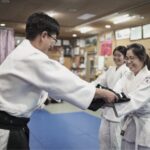
A female member practicing ukemi
■ Learning through repetition
During this morning’s session, a member who was practicing ukemi said this, as if scolding herself:
“My head knows what to do, but why won’t my body listen? I feel like such a fool.”
And a moment later, she added:
“I guess there’s no way around it except to keep repeating it until I get it right.”
She already knew the answer. Through repetition, one’s actions and thoughts gradually change, and once that changed mind and behavior accumulate, it eventually becomes possible to become aware of and control even unconscious instinct.
The body’s habits don’t change overnight. A habit formed over a long period of time only turns into a new habit once it has undergone that same amount of time and repetition. There’s no reason at all to be hard on yourself today just because you couldn’t get it perfectly right this time. In fact, becoming aware of your own habit is itself the first step of change. A habit you’re not aware of cannot be fixed, but a habit you’ve become aware of can be changed, no matter how long it takes, through repetition. Being just a little more mindful than yesterday, practicing just a little more than before—that’s how training accumulates, little by little.
■ When training on the mat carries over into life
Everyone acts unconsciously, and speaks unconsciously. And because of those words and actions, someone may end up getting hurt. But even bad habits that arise unknowingly to ourselves can be fully changed through learning by repetition.
Just as one masters the technique of falling through repetition, one can also cultivate one’s mindset and attitude toward others through repetition. Aikido is exactly that kind of movement, and exactly that kind of martial art. Today as well, the members of the morning session repeated their practice on the mat over and over, continuing their exercise in confronting their own instincts.