

I often post Aikido videos on my YouTube channel.
When I read comments praising Aikido or saying a video was fun to watch, it lifts my mood and fills me with the passion to make even better videos.
But it’s not always positive comments.
Sometimes people leave comments saying the techniques in Aikido videos look fake or make no sense, calling them unrealistic.
Even I sometimes think, watching it back, that no one would believe it.
Recently, a comment criticizing Aikido appeared under a video on the Jeju Oseung Dojang YouTube channel.
Most of these comments start out debating whether Aikido is “practical,” but end up turning into personal attacks on whoever they’re arguing with.
A common pattern is someone who has barely tried Aikido, or never tried it at all, dismissing it outright, and the conversation inevitably ends up at “prove it by winning a tournament, then I’ll believe you.”
It’s like someone who dislikes the taste of a dish simply choosing not to eat it, yet instead mocking the people who are happily eating it and asking why they’d even want to.
Responding to every one of these comments does take a toll on the spirit, honestly.
People around me often tell me not to bother replying to attention-seekers like that.
Aikido was not created to win competitions.
It was even less created for picking fights in the street like a thug looking for trouble, or for beating people around you just because they annoyed you.
The essence of Aikido is not creating situations to fight in the first place.
Every technique expressed or trained in Aikido is about finding and training the best possible response to some outside act of violence.
Rather than meeting violence with violence, we look for ways to avoid it and neutralize it.
Aikido is a martial art that searches for a kinder way than “an eye for an eye, a tooth for a tooth.”
In the dojang, we train by studying techniques and analyzing our partner’s force in order to find that kinder, better way.
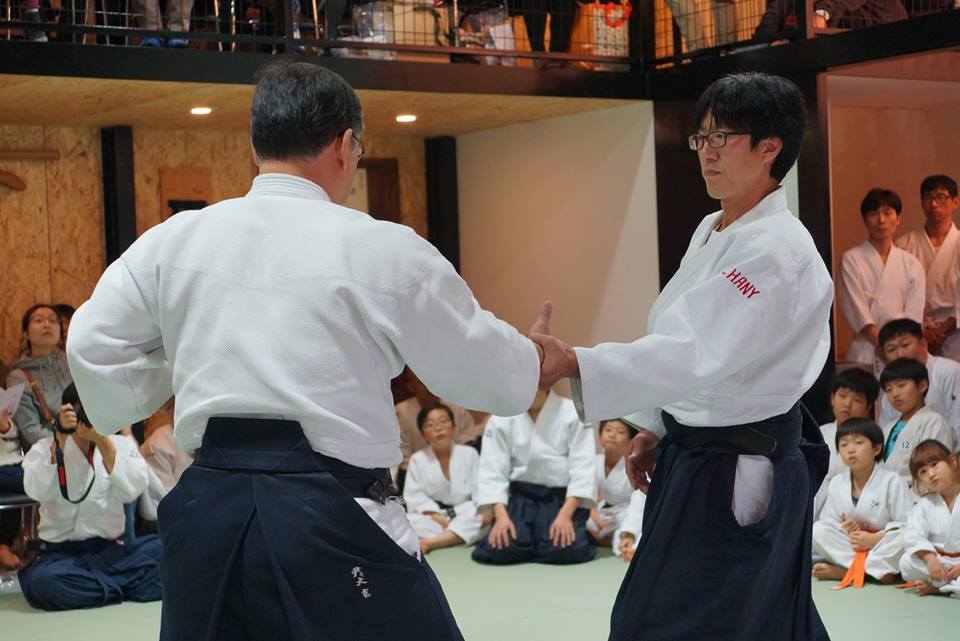
Some people scoff, “Who actually grabs someone’s wrist in a real fight?”
There are several reasons why Aikido uses wrist grabs.
One is that having your wrist grabbed lets you feel your own power being blocked, and lets you understand how your partner’s force connects to your center.
Of the many reasons, the wrist grab is simply the easiest way to understand these two things.
The techniques expressed through wrist grabs aren’t meant to be literal self-defense moves for “what to do if someone grabs your wrist.”
Once you understand, through wrist grabs, how your own power gets blocked and how your partner’s force connects to your center, then if your technique is truly complete, you’ll be able to apply it no matter how your partner grabs or attacks you.
If you try to memorize techniques the way you memorize a times table, the list of techniques to remember becomes endless.
Learning that many techniques requires a great deal of physical stamina, and naturally, people tend to give up as they age.
But if you understand the underlying principle of the times table, division comes naturally too.
Every technique in Aikido connects back to finding where your partner’s attack connects to you, and resolving that root cause.
That’s why it’s nearly impossible to understand what Aikido is really pursuing after just “a few days” of training.
Of course, there’s nothing wrong with seeking out a specialized gym focused purely on winning fights and learning techniques quickly — the way some students seek out a star tutor just to beat their classmates on a math test.
But you should understand that Aikido was not made to help you beat your friends, and it was not created to help you fight better than the people you train alongside.
Aikido is a martial art made so that we can share, study, and find happiness together with one another.
There’s a lot of mockery out there along the lines of “Aikido is just something old folks do.”
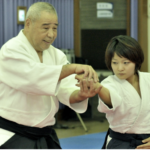
Aikido is one of the very few martial arts you can practice when you’re young and continue practicing well into old age.
The fact that it can be practiced into old age proves that, with a long enough career, it’s a martial art where you can still sweat and connect with younger practitioners as equals.
About three or four times a year, seminars are held led by senior teachers in their eighties.
Through Aikido, we get to learn from the wisdom of these senior teachers.
Many say Aikido has helped them a great deal in their social and professional lives.
Life is the real thing, Joneman.
It’s a line often said as a joke, but we all know it’s true.
The “real fight” in Aikido is making the effort to live a happier, more joyful life.





I believe real combat is, quite literally, the war we face every day.
And yet, these days, most people think of “real combat” as the unrealistic matches held in a ring.
I think there are as many forms of real combat as there are people.
So, for you reading this right now — what does real combat mean to you?
For me, the real battle is fighting and beating cancer!
My real challenge is doing sword techniques and Aikido without hurting my wrist.